

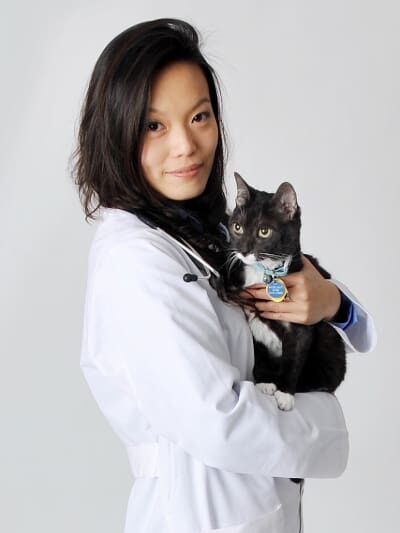
Dr. Andrea Y. Tu Chief of Veterinary Behavior Medicine, DVM, DACVB- USDA Accredited
Click Here for Behavior Appointments
Dr. Andrea Y. Tu, DVM, DACVB, is a diplomate of the American College of Veterinary Behaviorists and New York City’s most established board-certified veterinary behaviorist, having provided veterinary behavioral consultations in the city since 2013. A rare hybrid veterinarian, she bridges two disciplines in her role as Chief of Veterinary Behavior Services at the Heart of Chelsea Veterinary Group while continuing to provide comprehensive medical care as a general practice veterinarian.
Raised in Taipei, Taiwan, and Lexington, Massachusetts, Dr. Tu earned her B.A. in Biopsychology from Barnard College of Columbia University in 2000. After graduation, she spent six years conducting developmental behavior research at the New York State Psychiatric Institute while volunteering with human–animal bond outreach programs throughout New York City.
Dr. Tu completed her Doctor of Veterinary Medicine at the Cornell University College of Veterinary Medicine in 2010. During veterinary school, she served as president of the Student Chapter of AAHA, co-founded the Surgery Club, coordinated the inaugural Zoonotic Diseases Symposium, and gained extensive experience in veterinary behavior through the Cornell Animal Behavior Clinic and with various veterinary behaviorists in the tri-state area. Following graduation, Dr. Tu completed a Small Animal Medical and Surgical Rotating Internship at Red Bank Veterinary Hospital in Tinton Falls, New Jersey. She then spent six and a half years as a general practice veterinarian at Park East Animal Hospital, followed by six years as the Medical Director for Behavior Vets of New York.
Dr. Tu earned her board certification after completing her residency training with the American College of Veterinary Behaviorists under the mentorship of New York City’s first veterinary behaviorist, Dr. Elise Christensen, DVM, DACVB. Dr. Tu is honored to be one of fewer than 100 board-certified veterinary behaviorists in North America.
In addition to her clinical work, Dr. Tu serves as the Chief Medical Advisor for PAWS NY, an organization dedicated to preserving and supporting the human–animal bond for New York City’s most vulnerable residents. Her primary professional interests include veterinary behavior, surgery, and fostering healthy, lifelong relationships between people and their pets.
Dr. Tu has lectured nationally and internationally on animal behavior and has authored multiple peer-reviewed research articles and book chapters. Her expertise has been featured widely across print and broadcast media, including The New York Times, The Wall Street Journal, The New Yorker, Animal Planet, CBSInteractive.com, Fox 5 News, Cheddar News, and international television networks in Canada, France, and Taiwan. She appeared in the documentary Furever, produced a series of pet-care videos for the American Kennel Club, and was featured in the “Dogs” episode of the Netflix series The Future Of. She is available for media inquiries and speaking engagements.
A USDA-accredited veterinarian, Dr. Tu holds active veterinary licenses in New York, New Jersey, and California, and is a member of the American College of Veterinary Behaviorists (ACVB), the American Veterinary Society of Animal Behavior (AVSAB), the American Veterinary Medical Association, the New York State Veterinary Medical Society, and the Veterinary Medical Association of NYC.
In her spare time, Dr. Tu, who is fluent in Chinese, enjoys fostering kittens for rescue groups as well as sampling the city’s various culinary offerings. Despite having had over 20 dogs in her life, she currently shares her home with two clicker savvy, training obsessed cats named Kahlua and Beignet, and her not-as-well-trained husband, Mark.
Publications – Journal Articles
Tu, A. Y., Springer, C. M., & Albright, J. D. (2024). Evaluation of characteristics associated with self-identified cat or dog preference in pet owners and correlation of preference with pet interactions and care: An exploratory study. Animals, 14(17), Article e2534. https://doi.org/10.3390/ani14172534
Tu, A. Y., & Christensen Bell, E. (2023). Owner-directed aggression in a 2-year-old male neutered domestic shorthair cat: A case report. Journal of Veterinary Behavior, 63, 10–15. https://doi.org/10.1016/j.jveb.2023.03.001
Myers, M. M., Ali, N., Weller, A., Brunelli, S. A., Tu, A. Y., Hofer, M. A., & Shair, H. N. (2004). Brief maternal interaction increases number, amplitude, and bout size of isolation-induced ultrasonic vocalizations in infant rats. Journal of Comparative Psychology, 118(1), 95–102. https://doi.org/10.1037/0735-7036.118.1.95
Sibolboro Mezzacappa, E., Tu, A. Y., & Myers, M. M. (2003). Lactation and weaning effects on physiological and behavioral responses to stressors. Physiology & Behavior, 78(1), 1–9. https://doi.org/10.1016/S0031-9384(02)00889-2
Currie, P. J., Saxena, N., & Tu, A. Y. (1999). 5-HT2A/2C receptor antagonists in the paraventricular nucleus attenuate the action of DOI on the NPY-stimulated eating. NeuroReport, 10(14), 3033–3036. https://doi.org/10.1097/00001756-199909290-00029
Publications – Books
Tu, A. Y., & Radosta, L. (2024). Prevention: The best medicine. In G. Landsberg, L. Radosta, & L. Ackerman (Eds.), Behavior problems of the dog and cat (4th ed., pp. 61–75). Elsevier. https://doi.org/10.1016/B978-0-7020-8214-6.00014-0
Tu, A. Y. (2024). The patient-friendly reception area. In P. Miller & L. Sinn (Eds.), Veterinary cooperative care: Enhancing animal health through collaboration with veterinarians, pet owners, and animal trainers (pp. 74–97). Dogwise Publishing.
Publications – Abstracts
Bauer, J., Brunelli, S. A., Tu, A. Y., & Myers, M. M. (2006). Prenatal exposure to fluoxetine increases pain thresholds of infant rats. International Society for Developmental Psychobiology, Abstracts, 48, 605.
McLeod, S. A., Tu, A. Y., Graham, P., & Myers, M. M. (2005). Effects of prenatal caloric restriction in rats on efficiency of weight gain. International Society for Developmental Psychobiology, Abstracts, 47, 438.
Kurtzman, J., Brunelli, S. A., Muller, J., Tu, A. Y., & Myers, M. M. (2005). Effects of acute fluoxetine treatment on impulsivity in juvenile rats. International Society for Developmental Psychobiology, Abstracts, 47, 435.
Myers, M. M., Tu, A. Y., Graham, P. A., & McLeod, S. A. (2004). Food restriction during pregnancy in rats: Effects on physiology and feeding behavior in adult offspring. International Society for Developmental Psychobiology, Abstracts, 45, 279.
Valdman, O., Moore, H., Tu, A. Y., & Myers, M. M. (2003). Effects of prenatal caloric restriction in rats on social play and sensorimotor gating. International Society for Developmental Psychobiology, Abstracts, 43, 276.
Vosatka, R. J., Tu, A. Y., & Myers, M. M. (2003). Maternal diet programs physiology in rat offspring: Epigenetic regulation of Glut4 expression and altered glucose homeostasis. Pediatric Research, 53(4), 58A.
Myers, M. M., Tu, A. Y., Polin, G. A., & Shair, H. N. (2002). Effects of low protein diet during gestation on neonatal rat ultrasonic vocalization responses to brief maternal separation. International Society for Developmental Psychobiology, Abstracts, 41, 316.
Tu, A. Y., Myers, M. M., & Mezzacappa, L. (2001). Stress responsiveness in lactating and weaned mother rats. International Society for Developmental Psychobiology, Abstracts, 41, 97.
Gupta, A., Myers, M. M., Jeffery, J. A., Tu, A. Y., Bagiella, E., & Vosatka, R. J. (2001). Epigenetic implications of perinatal programming. Mead Johnson Nutritionals of Greater New York Conference on Perinatal Research, Abstracts.
Vosatka, R. J., Gupta, A., Jeffery, J. A., Tu, A. Y., & Myers, M. M. (2001). Perinatal programming: An epigenetic effect? Epigenetics Gordon Conference, Abstracts.
Myers, M. M., Ali, N., Brunelli, S. A., Weller, A., Tu, A. Y., & Hofer, M. A. (2000). Differences in number, amplitude, duration, shape and bout structure of isolation-induced infant rat ultrasonic vocalizations (USV) before and after a brief maternal reunion (potentiation). International Society for Developmental Psychobiology, Abstracts, 38, 209.